

Quick Summary
Garbage disposals are tougher than you think, but certain foods and everyday habits can bring them to a grinding halt, especially during Thanksgiving. Here’s what you need to know:
Key Takeaways
- Three biggest troublemakers: Fibrous foods like celery can jam moving parts, starchy foods like potatoes can clog drains, and grease can build up inside pipes.
- Cold water is your friend: Run cold water while using the disposal to help flush food particles and keep fats relatively solid. But never pour grease down the drain.
- Humming doesn’t mean dead: If your garbage disposal hums but won’t spin, it may simply be jammed. The reset button and hex-wrench port can often help.
- Know the difference: A disposal that runs but won’t drain likely has a plumbing blockage, while one that hums without spinning may have a mechanical jam.
- Thanksgiving survival tip: Keep potato peels, turkey grease, celery strings, and large amounts of food scraps out of the disposal, especially when cooking for a crowd.
First, Your Garbage Disposal Doesn’t Actually Have Blades
This surprises people. Despite what we’ve all been told, most residential garbage disposals don’t have sharp, spinning blades like a blender. Instead, there’s a rotating metal plate with small swinging impellers. As the plate spins, those impellers push food against a stationary grinding ring around the chamber’s edge. The food gets broken into smaller pieces, which are then carried away by running water. That’s an important distinction because it explains why some foods cause problems.
A disposal is designed to grind food into particles small enough to travel through your plumbing. It’s not designed to chop long fibers, dissolve starch, or make grease disappear. And when something prevents that rotating plate from moving, the motor can stall. Keep trying to run it, and you risk overheating the motor or tripping its built-in overload protector. So what causes the most trouble?
The Three Food Categories That Cause the Most Garbage Disposal Problems
1. Fibrous Foods: The Ones That Wrap Around Everything
Celery, asparagus, corn husks, artichoke leaves, and certain vegetable stalks are surprisingly tough on garbage disposals. The problem isn’t that they’re too hard. It’s that they’re stringy. Instead of breaking apart cleanly, long fibers can wrap around the rotating components or become trapped near the grinding ring. Think of winding string around a spinning axle. Eventually, enough resistance can prevent it from turning.
Celery is a classic example. Those long strings running through the stalk don’t always break down easily, especially in older or lower-powered disposals. Corn husks are another problem, particularly around Thanksgiving when people are preparing large meals and tossing scraps into the sink. Better approach: Put stringy vegetable scraps in the compost or trash. A few small pieces might not hurt anything, but feeding an entire pile into the disposal is asking for trouble.
2. Starchy Foods: The Ones That Turn Into Paste
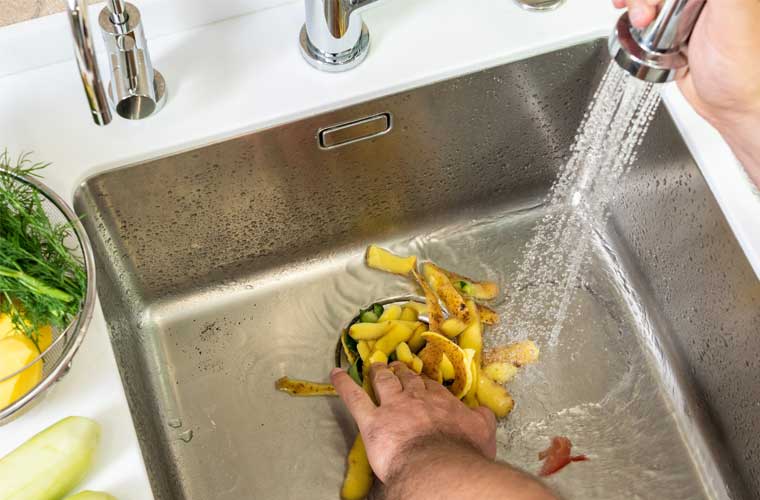
Potatoes, rice, pasta, and large quantities of vegetable peels create a different problem. They don’t necessarily jam the motor. Instead, they can form thick, sticky masses that interfere with drainage. Consider what happens when you mash potatoes. You take a starchy food, break it into smaller pieces, add moisture, and create a thick paste. Now imagine doing that inside your garbage disposal.
A large amount of potato waste can become a dense slurry that moves poorly through the discharge opening, P-trap, or kitchen drain. Rice and pasta are also problematic because cooked starches can clump together, while uncooked pieces may absorb water and swell. This is why a disposal can sound perfectly normal while the sink refuses to drain.
The machine is grinding, but the plumbing isn’t clearing. Manufacturers generally recommend feeding acceptable food scraps gradually rather than dumping large quantities into the chamber at once. InSinkErator specifically warns against overloading the disposal with vegetable peels in its food waste disposer care instructions.
3. Grease and Fat: The Problem That Travels Downstream
Bacon grease, turkey drippings, butter, cooking oil, and meat fat are especially troublesome during the holidays. But here’s the interesting part.
Grease usually isn’t damaging the garbage disposal’s grinding components. It’s damaging the plumbing downstream. When grease is warm, it flows easily. That makes pouring it down the sink seem harmless. But as it travels through cooler plumbing, animal fats can solidify, while oils and other greasy residues can cling to pipe walls. Over time, these deposits catch food particles and other debris, narrowing the passage through the drain. Eventually, water starts draining slowly or stops altogether.
Your disposal might still run beautifully. Unfortunately, everything it’s grinding has nowhere to go. The safest option is to collect cooking grease in a heat-safe container, let it cool, and dispose of it according to local waste guidelines. For homeowners already experiencing slow drainage, professional drain cleaning services can address buildup that a functioning disposal cannot remove.
Cold Water or Hot Water? Here’s What Actually Matters
You’ve probably heard that you’re supposed to run cold water when using your garbage disposal. That’s generally correct, but the reason gets misunderstood. Some people believe cold water keeps the blades sharp. Others think hot water damages the motor.
Neither explanation really gets to the point. Cold water helps keep fats relatively firm while they’re being ground and flushed through the disposal. Hot water can temporarily liquefy fats, allowing them to travel farther into the plumbing before cooling and accumulating.
But there’s an important catch. Cold water does not make pouring grease down the drain safe. Even if fat stays relatively solid during grinding, it can still contribute to a blockage farther downstream. The grease rule is primarily about protecting your pipes, not preserving imaginary disposal blades.
InSinkErator recommends running a moderate stream of cold water during operation and continuing to run it afterward. It also notes that draining hot water through the unit between grinding sessions is generally fine.
Here’s a good everyday routine:
-
Turn on a moderate flow of cold water.
-
Start the disposal before adding food scraps.
-
Feed small amounts of suitable waste gradually.
-
Let the disposal finish grinding.
-
Keep the disposal and water running for roughly 15 seconds after the grinding noise stops, or follow your model’s instructions.
That final flush matters because ground food still needs enough water to move through the trap and into the drain.
Garbage Disposal Humming but Not Working? Don’t Keep Flipping the Switch
Let’s get back to that dreaded humming sound. If your garbage disposal hums but doesn’t spin, it usually means the motor is receiving electricity but can’t rotate the grinding mechanism. Something may be physically blocking the plate. It could be a piece of bone, a fruit pit, a utensil, or a small object that accidentally fell into the sink. Sometimes food debris is enough to cause a jam.
The good news? A humming disposal isn’t automatically a dead disposal. In many cases, you can clear the obstruction without replacing the appliance. But the first thing to do is turn it off. Repeatedly powering a stalled motor can cause overheating and potentially damage it.
Step 1: Disconnect the Power
Turn off the wall switch, then unplug the disposal beneath the sink. If it’s hardwired, switch off the appropriate circuit breaker. Never put your hand inside the disposal, even when the switch is off.
Step 2: Find the Hex-Wrench Port
Many InSinkErator models have a small hexagonal opening in the center of the disposal’s underside. It’s designed specifically for clearing jams. Insert the manufacturer’s disposal wrench or, on compatible models, a standard 1/4-inch Allen wrench. Move the wrench back and forth until the grinding plate begins rotating freely. You’re not trying to force the motor to run. You’re manually freeing the mechanism. Not every disposal has this port. Some brands use a different unjamming procedure, so check your model’s instructions.
Step 3: Check for Obstructions
With the power still disconnected, use a flashlight to look inside the grinding chamber. If you see something lodged near the grinding ring, remove it using long-handled tongs or pliers. Never use your fingers.
Step 4: Locate the Reset Button
Many disposals have a small red reset button underneath the unit. This button is connected to the motor’s overload protection system. If the motor overheated or became overloaded, the protector may have interrupted power. Allow the motor to cool according to the manufacturer’s instructions, then press the reset button if your model has one.
Reconnect power, run cold water, and briefly test the disposal. If it starts grinding normally, you’ve probably solved the problem. For model-specific guidance, see InSinkErator’s official jam-clearing instructions.
What If the Disposal Is Completely Silent?
A disposal that doesn’t hum, click, or make any noise presents a slightly different situation. The problem could be a tripped overload protector, an unplugged power cord, a tripped circuit breaker, a faulty switch, or an electrical failure inside the unit.
Check the obvious things first. Make sure the outlet has power, the breaker hasn’t tripped, and the disposal’s reset button hasn’t popped. If the unit still won’t respond, don’t start taking apart electrical components unless you’re qualified to do so. And if you notice a burning smell, smoke, sparking, or water around electrical connections, leave the power disconnected and call a professional.
Is Your Garbage Disposal Broken, or Is Your Drain Just Clogged?
This distinction can save you from replacing a perfectly good appliance.
Here’s a quick way to recognize the difference.
| What you’re experiencing | What it may mean |
|---|---|
| Humming without spinning | Jammed grinding mechanism or motor problem |
| Completely silent | Power, overload protector, switch, or motor issue |
| Grinding normally but water backs up | Blockage in the disposal outlet or drain |
| Loud metallic rattling | Foreign object or loose component |
| Water leaking from the bottom housing | Possible internal seal failure |
| Repeatedly tripping the reset | Persistent jam, overload, or motor fault |
A disposal that runs normally while water backs up often needs drain attention rather than a new motor. And a disposal that leaks through its actual bottom housing, rather than a removable plumbing connection, may need replacement.
If you’re unsure which problem you’re dealing with, 5 Star Plumbing, Heating & Air provides garbage disposal repair and replacement along with kitchen plumbing services throughout Hemet, Riverside County, and surrounding communities.
Thanksgiving-Week Garbage Disposal Triage Before 40 People Arrive
Holiday cooking creates an unusual amount of kitchen waste in a very short period. Potato peels, turkey fat, vegetable trimmings, stuffing, gravy, and leftovers all compete for space in the same plumbing system. And if your disposal is already struggling, Thanksgiving dinner is not the time to see how much more it can handle. Here’s a practical plan.
Two or Three Days Before Thanksgiving
Run the disposal with cold water and listen for unusual sounds.
Check that the sink drains quickly after the disposal stops. Look under the cabinet for moisture around the disposal body, discharge pipe, and dishwasher connection. If you notice recurring jams, leaks, or slow drainage, schedule service before guests arrive.
Thanksgiving Morning
Put a large scrap bowl or compost container next to the cutting board. Keep potato peels, celery strings, corn husks, and turkey fat out of the sink.
Ask anyone helping with food preparation to do the same. It sounds simple, but when several people are cooking together, somebody inevitably assumes the disposal can handle everything.
If the Disposal Suddenly Stops
First, stop using it. If it’s humming, switch it off immediately and follow the safe unjamming procedure.
If the unit runs but water isn’t draining, stop adding food and water. You may be dealing with a drain blockage. Don’t pour chemical drain cleaner into the disposal. These products can create chemical exposure hazards, especially if someone later needs to disconnect the plumbing. And don’t keep running the dishwasher if it drains through the disposal and the sink is already backed up.
If water is leaking, the breaker repeatedly trips, or the disposal won’t operate after safe troubleshooting, it’s time to call a plumber. For urgent problems, professional plumbing assistance is a better option than experimenting with a malfunctioning appliance while the kitchen is full of guests.
Can You Prevent Garbage Disposal Problems Without Babying the Machine?
Absolutely. Garbage disposals are useful appliances, and many are tougher than homeowners realize. You don’t need to panic over every small food scrap. The goal is to understand what the appliance is designed to do. Use it for reasonable amounts of suitable food waste, not as a replacement for the trash can. Keep long fibers, large quantities of starch, grease, and nonfood objects out of it. Use cold water while grinding, and let the water run long enough to flush particles down the drain. Occasionally inspect the splash guard for trapped food residue, which can cause odors even when the disposal works normally.
And remember that lemon peels, ice cubes, and baking soda aren’t substitutes for clearing a mechanical jam or an actual pipe blockage. A disposal can be clean and still be broken. It can also be mechanically healthy while connected to a badly clogged drain. Knowing the difference is what keeps small problems from becoming expensive ones.
When Is It Better to Replace a Garbage Disposal?
Not every broken disposal needs replacement. A simple jam, tripped overload protector, or loose drain connection may be relatively straightforward to address. Replacement becomes more reasonable when the motor has failed, the internal housing is leaking, corrosion is extensive, or the unit repeatedly jams despite proper use and maintenance.
Age matters, too, but it isn’t the only consideration. A well-maintained older disposal that works reliably may be worth keeping. A newer disposal with a failed internal seal may not be economical to repair. The right decision depends on the appliance’s condition, the cost of repair, and whether the surrounding plumbing is functioning properly.
If you’re considering an upgrade, a plumber can also help determine whether a more powerful disposal makes sense for your household and whether the existing electrical and drain connections are suitable.
Keep the Holiday Drama Out of Your Kitchen Sink
Nobody wants to spend Thanksgiving afternoon under the sink with a flashlight and an Allen wrench. Fortunately, most garbage disposal problems are preventable.
Remember the three biggest troublemakers: fibrous foods that can wrap around moving parts, starchy foods that can clog the discharge and drain, and grease that accumulates inside plumbing. And if your garbage disposal starts humming without spinning, don’t assume it’s finished. Turn it off, disconnect the power, and check for a jam before considering replacement.
For homeowners in Hemet, Riverside, Temecula, Murrieta, Beaumont, and surrounding areas, 5 Star Plumbing, Heating & Air can help diagnose garbage disposal problems, repair or replace malfunctioning units, and address the drain blockages that sometimes accompany them. Visit 5 Star Plumbing, Heating & Air or call (951) 363-2911 to schedule service. Because the only thing that should be stuffed this Thanksgiving is the turkey, not your kitchen drain.