

Quick Summary
Low water pressure does not always mean your home needs new pipes. In many Hemet homes, the problem is a worn pressure regulator that controls the water entering the house. A simple pressure test can help determine whether the issue is the regulator, a clogged fixture, a partially closed valve, or the plumbing itself. Knowing your home’s water pressure can help you find the right fix and avoid paying for repairs you may not need.
Low Water Pressure Is Usually the Regulator
Weak showers make homeowners think about repiping. In most Hemet houses, the actual culprit is a single brass valve near the front of the property that has quietly worn out. Here is how to find out which one you have before you spend anything.
Poor water pressure is one of the most common complaints we hear, and one of the most commonly misdiagnosed. The homeowner pictures decades of mineral buildup narrowing every line in the walls and starts getting quotes for a whole-house repipe.
That is almost never what is happening. In the vast majority of whole-house pressure complaints, the pipes are perfectly fine. The problem is one brass fitting roughly the size of a fist, installed where the water enters your property, that has reached the end of a working life nobody told you it had.
You can narrow this down yourself in about ten minutes, for twelve dollars, before any plumber sets foot in the house.
Get a number before you get an opinion
Water pressure is measurable, so measure it. Any hardware store carries a water pressure test gauge for ten to fifteen dollars. It is a small dial with a female hose thread on the back, and it screws onto an outdoor spigot like a garden hose.
- Choose the spigot closest to the street. Typically the front of the house, nearest where the service line comes in. That gives the cleanest reading of what the house is being handed.
- Shut down everything that uses water.No dishwasher, no washing machine, no irrigation timer about to fire. An ice maker cycling mid test will skew the number.
- Thread the gauge on by hand tight and open the valve all the way. No tools needed. The rubber washer does the sealing.
- Read the dial with nothing running. This is static pressure, the number that tells you whether the house is being supplied correctly.
- Now open a shower and two faucets and read it again. This is working pressure. The gap between the two readings is the most useful thing you can learn without tools.
A static reading of 50 to 70 PSI is typical for a residential system. Under 40 and every fixture feels tired. Over 80 and you have a different problem, one that California plumbing code treats seriously enough to require a pressure reducing valve on the line.
Pay attention to the second reading too. If static sits at a healthy 62 but collapses to 25 the moment a shower opens, you do not have a pressure problem. You have a volume problem, meaning a restriction downstream. That points toward a partially closed valve, a clogged filter, or corroded piping rather than the regulator.
The valve most homeowners have never seen
The water main in your street does not run at house pressure. The district pushes water across a whole zone and up whatever elevation the neighborhood sits on, so main pressure in parts of the valley runs well above 100 PSI. No residential fixture is built for that.
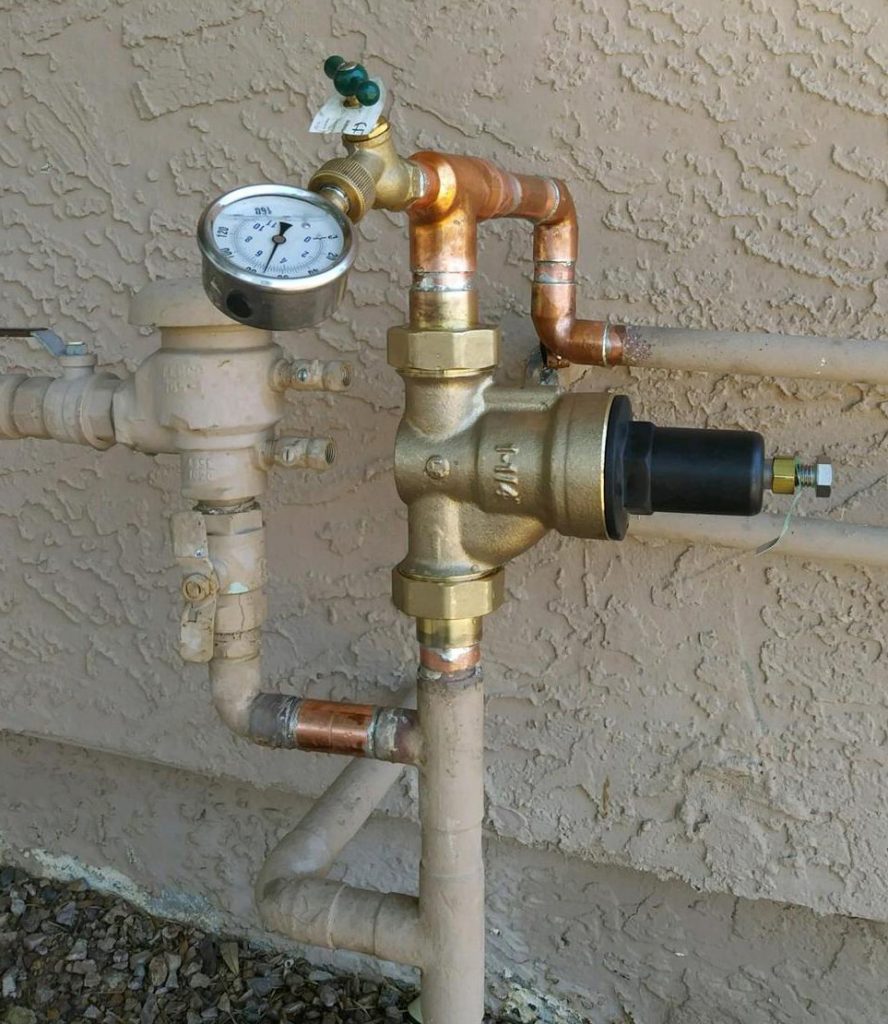
The part that solves this is the pressure-reducing valve, commonly abbreviated as PRV. It is a bell-shaped brass body installed on the main line just after it enters your property, and its sole job is to take whatever the street sends and deliver to the house a lower, steadier number. There is an adjustment bolt on top with a locknut under it.
Finding yours takes a walk. Look near the main shutoff at the front of the house, often inside a plastic or concrete box set into the ground near the sidewalk. Sometimes it sits above ground beside the spigot nearest the street, and in newer construction it may be inside the garage wall. In homes landscaped a few times, it is buried beneath a shrub that has grown over the access box.
Typical service life runs 10 to 15 years, and is closer to 10 in hard water. If your house is fifteen years old and nobody has ever touched the regulator, it is original equipment well past its rated life.
Failing regulators go one of two directions, and they feel completely different.
The first is a slow drift downward. The diaphragm stiffens, the valve throttles more than it should, and the delivered pressure falls slightly each month. Nobody caught this one early because there was no day when the water suddenly got worse. Families adapt to a weaker shower over two years and only notice when a guest mentions it.
The second is worse. The valve fails open, and street pressure passes straight through. Now your fixtures see 100 PSI or more, and the symptoms read as an unrelated set of problems. Pipes bang when a faucet shuts. Toilets run on their own. The relief valve on the water heater weeps. Faucets spit and sputter. Eventually a washing machine hose or a toilet supply line lets go while nobody is home.
If your gauge reads over 80, treat it as urgent even though nothing feels wrong.
One related detail. A working PRV turns your plumbing into a closed system, so heated water has nowhere to expand. That is why a house with a regulator also needs a thermal expansion tank at the water heater. If yours is missing or waterlogged, you get a pressure spike every time the heater runs.
Whole house or one fixture
Before you call anyone, answer this question. It sorts the problem into four very different buckets, and it costs nothing.
The other usual suspects
Aerators. Hemet water is hard, and mineral flake collects in the small screen at the tip of every faucet. Unthread it, soak it in white vinegar overnight, rinse and reinstall. If one faucet improves dramatically, do the rest of the faucets in the house.
Valves that are not fully open. Anyone who has worked on the house may have left the main or an angle stop partly closed. Older gate valves also fail internally, with the stem turning freely while the gate stays put, so a valve that feels open is not necessarily open.
Galvanized steel pipe. This is the one case where the pipes really are the answer. Homes built before roughly 1970 may still have galvanized supply lines, which corrode inward and narrow over decades of use. It presents differently than a bad regulator. Pressure is worst at the fixtures farthest from the heater, worse on hot than on cold, and you see rust-colored water after the house sits empty for a few days. That one does call for a repipe.
The district. Sometimes it genuinely is not your house. Crews flush hydrants, mains break, and new construction upstream changes the picture. If the whole street noticed the same drop the same week, call Eastern Municipal Water District before you call a plumber.
What to try, and when to stop
Worth doing yourself in an afternoon.
- Run the gauge test and write down both readings.
- Clean every aerator and showerhead in the house.
- Confirm the main shutoff is fully open, not just most of the way.
- Replace the whole-house filter cartridge if you have one and cannot remember when it was last changed.
Worth a phone call instead.
- Static pressure under 40 or over 80 PSI.
- A regulator that is original to a house more than a dozen years old.
- Banging pipes, a weeping water heater relief valve, or toilets that run on their own.
- Hot water is weak everywhere while cold is fine.
- Rust colored water, or known galvanized piping.
Replacing a pressure reducing valve is a straightforward job on an accessible line. It costs a fraction of a repipe, and in most Hemet homes with a whole house pressure complaint, it is the entire fix.
Find out what your house is actually running at
If your gauge came back outside the 50 to 70 range, or you cannot find a regulator at all, we can test the line and tell you in one visit whether you are looking at a part replacement or something larger.
5 Star Plumbing, Heating & Air serves Hemet, San Jacinto, Menifee, Temecula and the surrounding Riverside County communities.